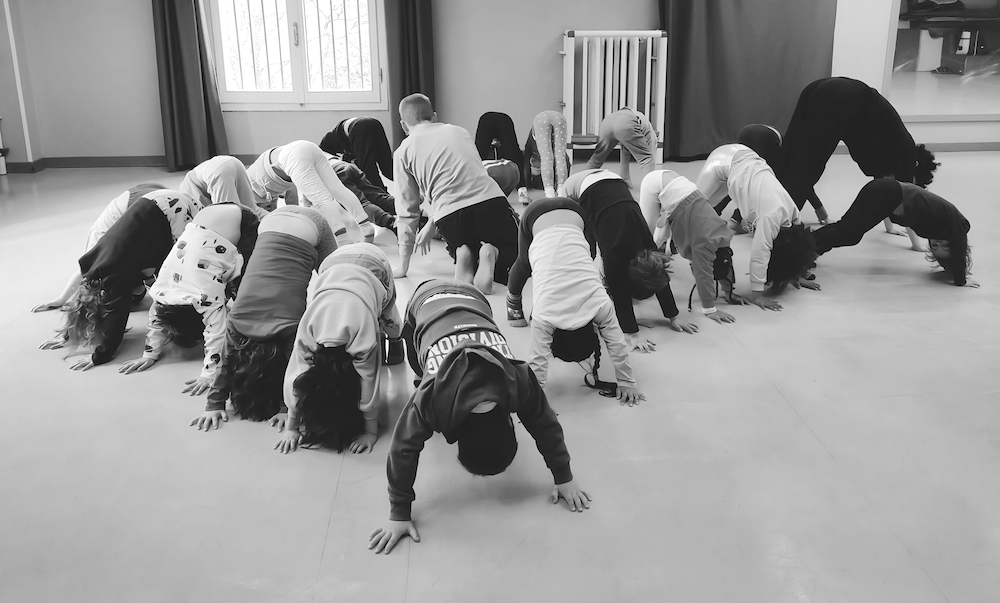
movement workshop for children (5 - 10 years)
held by Nicola Galli and Giulia Melandri
giardino motorio • kids is an educational project focused on the body and movement, inspired by the idea of a garden as a place of care and growth.
Structured as a series of workshops for children aged 5 to 10, from the final year of preschool through primary school, the project places the
body at the heart of the experience, recognising it as a primary tool for learning, expression and connection.
Following a methodology that alternates between action, creation and observation, giardino motorio • kids offers playful practices and creative
movement activities that guide participants on a journey of self-discovery, helping them explore their expressive potential and discover new ways of relating to others.
Through dance and creative movement, children explore perceptions, sensations and emotions, while experimenting with forms of interaction
based on listening, care and reciprocity.
The project supports and celebrates each child’s individual qualities, while fostering personal growth and collective well-being.
Workshop Structure
• 1 introductory meeting to present the activity to teachers and educators, and to share the methodology and objectives
• 5 sessions held during school hours
• 1 afternoon session dedicated to the group and their families: a shared time for discovering and exploring playful activities
and experiences that encourage new forms of egalitarian interaction, in which all bodies share the joy of movement.
Objectives
• To guide children in discovering and becoming more aware of their sensations and emotions through movement, dance and play
• To explore their own bodies and their boundaries in relation to space and other bodies
• To explore the concepts of space, time, duration, speed, waiting, action and rest
• To foster awareness of bodily care and encourage both individual and collective listening
• To experiment with rituals that support concentration and group awareness
• To encourage play between adults and children and foster new forms of egalitarian interaction